
Executive Summary
The Trademark Examination Guidelines of the KIPO (KIPO Established Rule No. 119) were partially revised and came into effect on January 1, 2021.
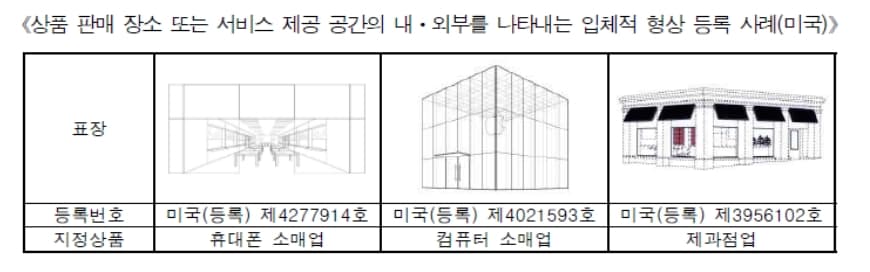
Through the above revision, the KIPO has expanded the scope of protection of non-traditional trademarks by recognizing ‘colors used in the interior and exterior of buildings and in specific locations of products’ as a type of non-traditional trademark. This is in consideration of the recent trend in which ‘trade dress’ functions as an important factor in product competitiveness and its function as a unique indication of the source of a product is strengthened. It allows ancillary elements (indications of subsidiary materials such as exterior windows of a building, arranged furniture, etc.), to which the applicant does not claim rights, to be expressed using dotted lines or a dashed-dotted lines, while maintaining the consistency of the overall appearance. US registered cases were announced as examples for reference.
Moreover, the functionality test procedure for the characteristics of non-traditional trademarks such as three-dimensional trademarks and color trademarks has been strengthened, in order to prevent elements that should be protected by a patent from being indefinitely protected by trademark rights. For example, it was provided that, for three-dimensional trademarks, the following four elements of the functionality test can be used as practical guidelines when examining non-traditional trademarks. And it was stipulated that the functionality test should be performed separately from the distinctiveness test when examining non-traditional trademarks. For color trademarks, it was provided that data such as the effect of the color in the field of the designated goods and the possibility of cost reduction in the manufacturing and usage processes can be checked to determine whether or not functionality exists.
(a) Existence of patents or utility models, (b) Existence of advertisements for product functions, etc., (c) Existence of other alternative shapes, and (d) Ease of production and economic feasibility of the alternative shapes, etc.
In addition, Chinese (simplified) has been added as an example of types of word marks, and it was stipulated that, even if a trademark is composed of a foreign language that is not well known to ordinary consumers, the trademark shall be treated as a word mark in its examination if the trademark itself is known widely enough to consumers that its appellation or notion is recognizable.